Being Found Isn’t Enough: Rethinking Discoverability
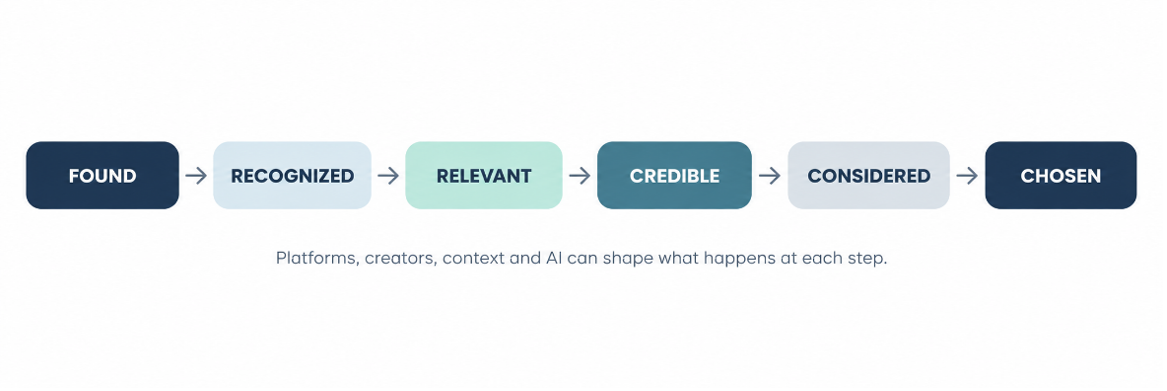
Brand discovery has become increasingly distributed. Consumers move among search engines, social platforms, creators, retail environments and AI-powered interfaces, often within the same decision journey. As those pathways multiply, discoverability is becoming less about occupying a single high-value position and more about maintaining coherence across a fragmented set of intermediaries. These intermediaries do more than provide access. They filter, rank, frame and interpret. A brand can be visible without being salient, salient without being trusted, and trusted without becoming a serious option.
Recent research underscores just how distributed this process has become. Clutch found that 85% of consumers say the way they discover brands has changed over the past five years; 59% said their most recent new-brand discovery happened online, while 78% had discovered a new brand while shopping in person (Peck, 2026). Circana similarly describes discovery as increasingly distributed across social platforms, retailers and brand sites, physical stores and AI-powered tools, with consumers often encountering a product in one environment, researching it in another and purchasing it somewhere else (Wyatt, 2026).
Being present across those environments, however, does not ensure that a brand will feel relevant when encountered. The ARF’s 2025 Privacy Study illustrates the limits of reach alone. Even in data-rich environments, 47–50% of ads on social media, streaming services and websites are still perceived as “sometimes” or “frequently” irrelevant (Garg & Zhang, 2026). The capacity to identify and target an audience therefore says relatively little about whether the resulting message will feel pertinent once it reaches them.
Relevance, in turn, depends partly on what captures attention and who or what delivers the message. An ARF synthesis of research on Gen Z and short-form video suggests that brief exposure can be effective when distinctive brand assets are immediately recognizable (Adams et al., 2026), while an ARF Knowledge Center synthesis of influencer marketing research finds that authenticity is consistently associated with trust, engagement and effectiveness (ARF Knowledge Center, 2026). In creator-led environments, another factor enters the equation: credibility. The intermediary is therefore not simply a channel through which discovery happens; it can become part of how the brand itself is evaluated.
The same is true of context, although more precise contextual matching does not automatically produce better outcome. In a recent ARF audio study with AMP and SiriusXM, matching the ad’s music genre to the listener’s immediately preceding music context did not reliably improve appeal, brand impression, consideration, trust or recall (ARF, in press). The finding suggests that greater contextual precision can reach a point of diminishing returns: adapting creative to every immediate signal may add complexity without making the brand more relevant or persuasive.
Taken together, these findings point to a broader shift. Discoverability increasingly depends on what happens between exposure and choice: how an intermediary interprets the brand, what information it emphasizes and how it positions the brand relative to alternatives. AI makes that process especially visible because interpretation is built directly into the discovery experience. In the latest ARF & MSI’s Psychology of Generative AI study, 97% of experienced AI users said AI recommendations can make them aware of brands they had not previously considered. The same proportion said they were more likely to consider an AI-recommended brand when the system explained why it made that recommendation. Meanwhile, 77% said AI recommendations can make them less certain about a brand they already prefer (Adams et al., in press-b).
AI can expand the consideration set—and unsettle existing preferences.
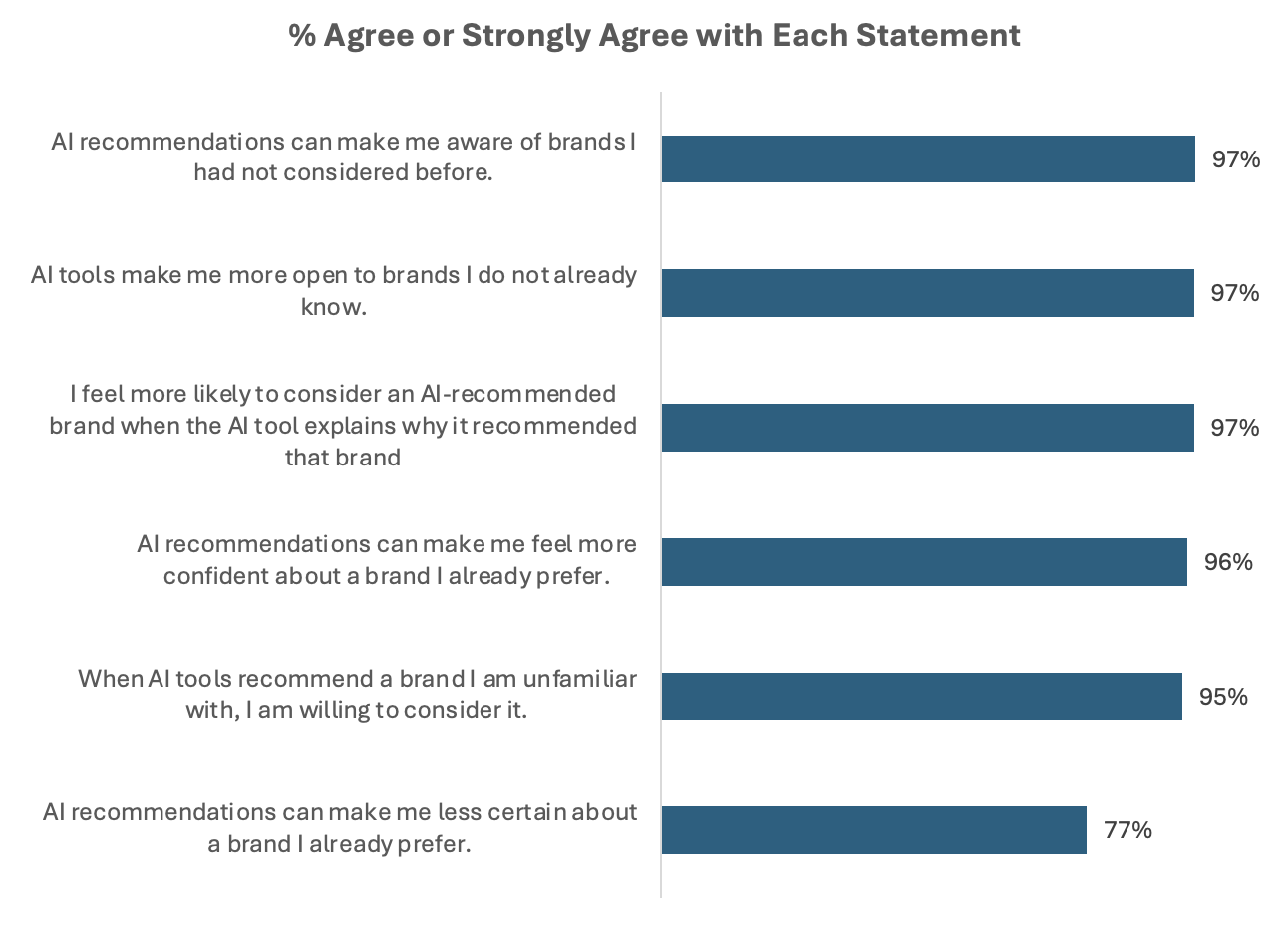
These results suggest that AI is doing more than surfacing options. It can shape how brands are described, compared and explained during the decision process, potentially strengthening some preferences while complicating others (Chahal, 2026).
A similar principle extends to agentic commerce. At CIMM Summit XV, AI shopping agents were described as a new class of customer that may never see an ad or click a link, instead evaluating brands through structured data. Brands increasingly need to be intelligible not only to people, but also to the systems acting on their behalf (Smallwood, 2026).
That expanded role for intermediaries also raises the stakes for trust. Nearly 60% of respondents in the ARF Privacy Study said they would share data in exchange for personalized shopping recommendations, while 85% said companies should disclose when they use AI and wanted transparency around data practices (Garg & Zhang, 2026).
As discovery becomes more mediated, measurement also needs to move beyond whether a brand simply appeared somewhere along the journey. An ARF Knowledge Center review of influencer marketing research identifies persistent gaps in connecting engagement and consideration to business outcomes, while the ARF & Ad Club’s retail media study highlights the importance of distinguishing attributed activity from incremental impact (Adams et al., in press-a; ARF Knowledge Center, 2026). For discoverability, rankings, impressions and clicks serve as measures of exposure. However, stronger measures would examine what happened because of that exposure: whether a brand entered memory, gained relevance, changed consideration or influenced choice.
The emerging challenge for marketers, then, is to build brands that remain coherent as they move across platforms, contexts and recommendation systems. Discoverability depends on being surfaced, but also on what happens after that moment: whether the brand is recognized, interpreted credibly, understood in context and carried forward through the decision process without losing its meaning along the way.
References
Adams, T., Donato, P., & Miles, L. (2026, June). Gen Z attention in short-form and social video: When brief exposure can matter. ARF.
Adams, T., Donato, P., & Zhang, S. (in press-a). Retail media measurement in practice: The buy-side view. In collaboration with The Advertising Club of New York.
Adams, T., Zhang, S., Smith, K. M., & Dones, C. (in press-b). The third actor: How AI is entering the consumer–brand relationship. ARF & MSI Psychology of Gen AI. ARF.
Advertising Research Foundation. (in press). Music priming study & connection. In collaboration with amp sound branding and SiriusXM/Studio Resonate.
Advertising Research Foundation Knowledge Center. (2026, July 1). ARF Knowledge Center overview: Influencer marketing—top member questions, known evidence and research gaps. ARF.
Chahal, M. (2026, September 1). AI cites brand websites more than press, Reddit or YouTube. WARC.
Garg, D., & Zhang, S. (2026, January). The ARF 8th annual privacy study. ARF.
Peck, A. (2026, August 17). The new rules of brand discovery: How consumers find brands in 2026. Clutch.
Smallwood, E. (2026, September 22). Machine marketing: Reaching customers when AI does the shopping. CIMM Summit XV conference, New York, NY. CIMM
Wyatt, S. L. (2026, July 17). New products, new paths to discovery. Circana
Author
Tracy Adams, PhD
Senior Director of Research & Insights
ARF