
Advertisers and Agencies Have Adopted AI. Now They Need to Prove It Works.
Artificial intelligence has moved quickly from experimentation to everyday use across advertising and agencies. AI already matters to marketing, media and creative work. What remains to be seen, however, is whether organizations can consistently turn AI use into meaningful, measurable and responsible business outcomes.
ARF research among 203 U.S. advertisers and agencies shows just how quickly the field is moving. The study, conducted in two waves in November 2025 and April 2026, demonstrates the breadth of adoption: AI is now used across text and image generation, campaign measurement and attribution, customer engagement, and automated media buying and optimization (Figure 1). AI is no longer limited to isolated tests or narrow productivity use cases. It is becoming embedded across both creative and media workflows.
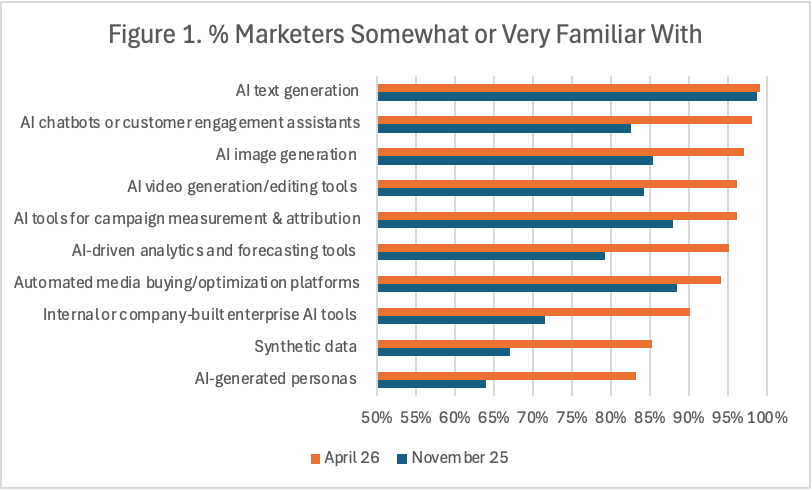
Use is also extending beyond the most familiar applications. Thirty-six percent of respondents reported using synthetic data, and 36% reported using AI-generated personas. These are still earlier-stage applications, but they point to where the industry is heading: AI not only as a productivity tool, but as a system for simulation, planning, testing and decision support.
Confidence in AI outputs is high and rising. Among those using each type of AI output, confidence increased from 82% in November to 93% in April. Yet the practices needed to justify that confidence are still developing. Only 47% of respondents said their organization
had conducted extensive testing of the AI tools it uses, while 43% reported only limited testing.
That gap matters. AI can help teams move faster, generate and refine ideas, automate workflows, summarize information, support reporting and improve access to analytics. Respondents pointed most often to increased efficiency and speed as a benefit of AI, followed by higher-quality insights and analytics, and improved targeting and personalization. But the benefits that are harder to prove — such as more accurate campaign measurement and attribution, better ROI and scaled business impact — remain more challenging.
This is where human expertise remains essential. Nearly half of respondents strongly agreed that AI outputs still require careful human review for quality and accuracy. That should not be read as resistance to AI. It is a sign of maturity. As AI moves from pilot to practice, the role of people becomes more important. Human judgment is needed to define the problem, assess whether an output makes sense, identify risk, interpret results and decide what evidence is needed before acting.
The good news is that governance appears to be catching up. Formal AI training programs grew from 50% in November to 70% in April. By the second wave, 89% of respondents said their organization had a dedicated person, role, team or department responsible for validating AI-generated measurement. More than half of organizations also reported having formal internal policies for generative AI use.
Of course, the industry is not fully there yet. While 48% of advertisers and agencies said they were aware of formal standards for the validity of AI output, the ARF study suggests that awareness often outpaces clarity. Many of the sources respondents identify are not marketing-specific standards, but a mix of voluntary guidelines, general technical frameworks and laws. As AI integrates deeper into campaign decisions, measurement, creative development and media optimization, that distinction becomes increasingly important.
For advertisers and agencies, the next phase of AI adoption will require more discipline and a clearer understanding of whether AI is making the work better, more reliable and more accountable. Does it improve decision-making? Does it strengthen measurement? Does it create efficiencies without introducing new risks? Does it support more creative and strategic work, or simply produce more output? And most importantly, how do organizations know? As AI shifts from experiment to infrastructure, the real measure of progress will be how well organizations can govern it, validate it and connect it to outcomes that matter.
Author
Tracy Adams, PhD
Senior Director of Research & Insights
ARF