
The Next Challenge for Media Planning: Knowing What Matters

As 2027 media plans take shape, marketers face increasingly complex decisions about where to invest, how frequently to reach audiences, and which content, environments, and partnerships will best support their objectives. Expanding media options, changing consumption habits, and advances in data and technology have created new opportunities for planning and optimization. Yet they also raise a fundamental question: How well do we understand the advertising effects we are trying to optimize?
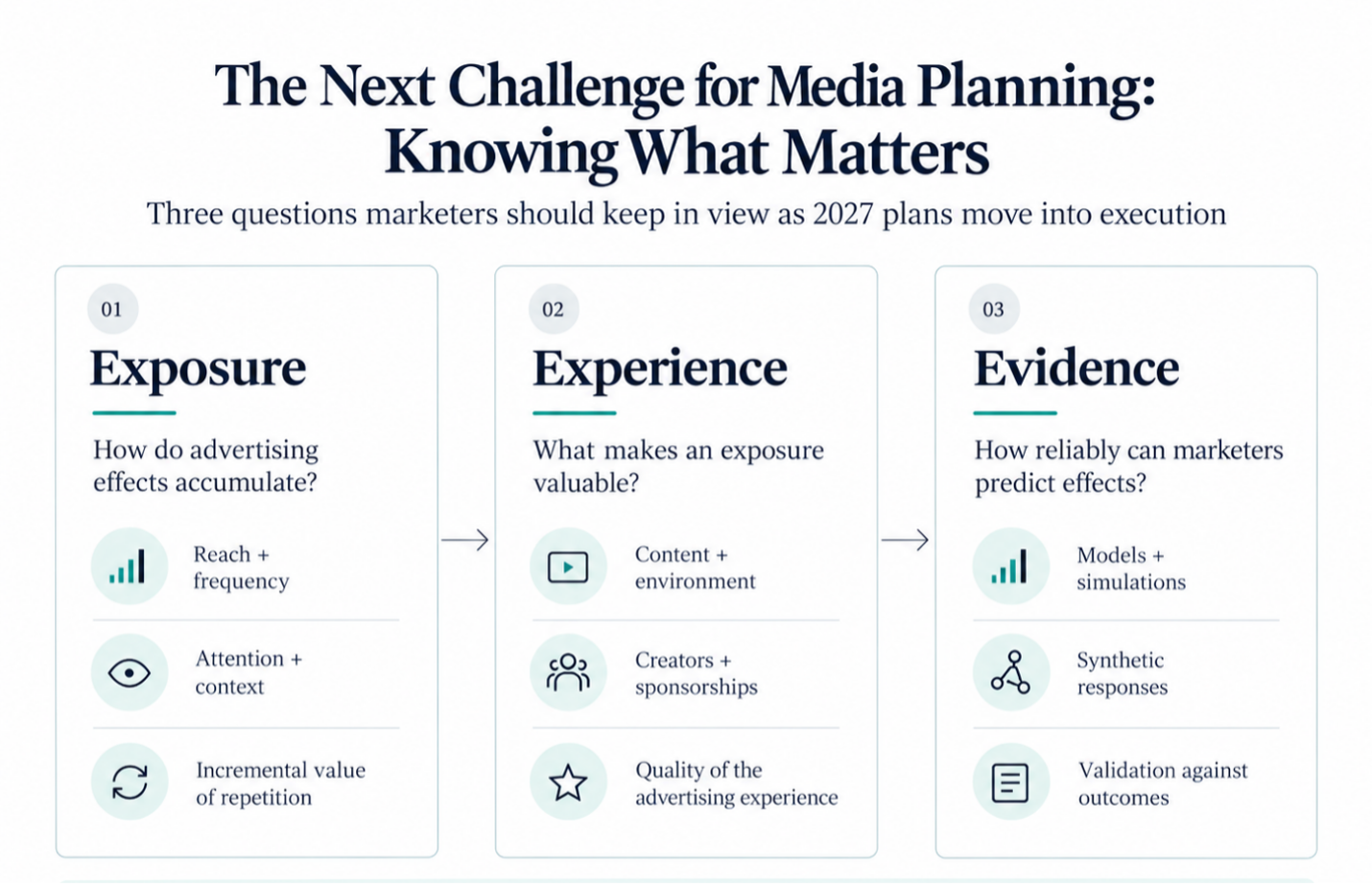
Research from the ARF, CIMM, and MSI (Adams et al., 2025) highlights persistent challenges in managing exposure across platforms, understanding how media investments work together, and connecting planning decisions to business outcomes. As plans move toward execution, three questions deserve particular attention: How do advertising exposures accumulate? What makes some advertising experiences more effective than others? And how reliably can marketers predict those effects?
Understanding How Advertising Exposures Accumulate
Reach and frequency remain fundamental to media planning, but exposures differ in duration, context, and the attention they receive. A brief encounter with an ad on social media, a television commercial viewed alongside a second screen, and repeated exposures across platforms may contribute differently to advertising outcomes. Understanding how these encounters accumulate, and when additional exposure produces additional value, remains an important challenge.
Research on attention complicates the picture. An ARF synthesis of Gen Z and short-form video research suggests that brief exposures can be effective when distinctive brand assets are immediately recognizable (Adams, Donato, & Miles, 2026). Meanwhile, the ARF’s Attention Measurement Validation Initiative found inconsistencies across measurement approaches, raising questions about how attention should be interpreted and applied (Adams, 2026; Adams, Donato, & Zhang, 2026). These findings underscore the importance of distinguishing exposure duration from attention and examining how both relate to advertising outcomes.
As cross-platform optimization capabilities advance, marketers can manage exposure patterns with greater sophistication. But frequency recommendations still depend on assumptions about repetition, creative characteristics, and viewing conditions. The ARF’s developing research on effective frequency seeks to investigate some of these relationships. For planners, the question is when additional exposure is likely to strengthen outcomes and when its incremental contribution may be limited.
Understanding What Makes an Exposure Valuable
Media planners must also consider how the content, source, and environment of advertising influence its effectiveness. Advertising experiences vary in content quality, source credibility, and media environment, raising questions about which characteristics contribute to consumer responses and under what conditions.
For creator-led advertising, potential sources of value include the creator’s expertise, personal experience, credibility, and relationship with their audience. Premium media raises related questions about content quality, the surrounding environment, and how audiences engage with advertising in different settings. These factors may matter in different ways, making it important to understand their relative contributions rather than assuming that a particular format or environment inherently delivers better outcomes.
The distinction has practical implications for media planning. Advertising opportunities with comparable audience delivery may differ in the experiences they create and the outcomes they support. The ARF is developing research on premium media and content quality, while also planning a separate study on influencer effectiveness. Together, these initiatives aim to clarify how content characteristics, media environments, and source credibility relate to advertising effectiveness across different audiences and conditions.
Understanding the Evidence Behind Planning Decisions
A third challenge concerns the reliability of the evidence used to guide investments. Predictive models can compare media plans and estimate campaign outcomes, while synthetic data and AI-generated consumer responses offer additional ways to explore scenarios before committing resources.
These applications serve different purposes and require different forms of validation. A model may generate plausible predictions without accurately reflecting consumer behavior or identifying the effects of a proposed investment. Its usefulness depends on data quality, modeling assumptions, and performance in the specific context where it will be applied.
The ARF, CIMM, and MSI (Adams et al., 2025) identified data quality, bias, and inaccurate simulation assumptions as risks for media planning. The ARF’s developing research on synthetic data aims to examine the validity of AI-generated research responses and the conditions under which they may be useful. For marketers, an important distinction is between using modeled evidence to explore possibilities and relying on predictions to allocate substantial budgets. The latter calls for stronger validation, ideally against observed outcomes or relevant human research.
Looking Ahead
As 2027 plans move into execution, marketers will have opportunities to test assumptions and refine their decisions. Some of the most useful advances may come from answering longstanding questions more precisely: how repetition works, what shapes the value of advertising experiences, and which predictions deserve confidence. Ultimately, the sophistication of a media plan should be judged by the quality of the decisions it supports and the outcomes those decisions help achieve.
References
Adams, T. (2026, August 25). ARF Knowledge at Hand: Practical learnings from the ARF Attention Measurement Validation Initiative. ARF.
Adams, T., Donato, P., Cohen, E., Watts, J., Smith, K., & Taylor, E. (2025, November). The future of media planning in an AI-powered, data-driven world. ARF.
Adams, T., Donato, P., & Miles, L. (2026, June). Gen Z attention in short-form and social video: When brief exposure can matter. ARF.
Adams, T., Donato, P., & Zhang, S. (2026, June). ARF Attention Measurement Validation Initiative: Phase 3. ARF.
Author
Tracy Adams, PhD
Senior Director of Research & Insights
ARF