
Behavior Is Shifting. Measurement Is Not Yet Aligned.

Third-party cookies have not disappeared overnight, but their central role in digital advertising has steadily diminished. Browser restrictions, platform policy changes, regulatory pressures, and shifting advertiser behavior have collectively altered the signal environment. The industry is clearly responding. The more difficult question is whether that response is coherent. Recent ARF research, including the 2025 Metrics Survey and our forthcoming study of Retail Media Networks (RMNs), suggests a pattern that is both encouraging and unsettled. Advertisers and agencies are adapting, often decisively. Yet measurement systems across platforms and networks remain uneven and difficult to compare.
The direction of travel is unmistakable. In the ARF 2025 Metrics Survey, 62% of agencies and 48% of advertisers report increasing their use of first-party data. Among the targeting approaches examined, first-party data shows the clearest upward movement. Privacy-safe collaboration tools are also widely embedded in practice: 76% of agencies and 64% of advertisers report using Google’s Privacy Sandbox, and 72% of agencies and 56% report working within clean room environments. Contextual advertising, often discussed as an alternative in privacy-constrained environments, is increasing as well, with 49% of agencies and 38% of advertisers reporting growth.
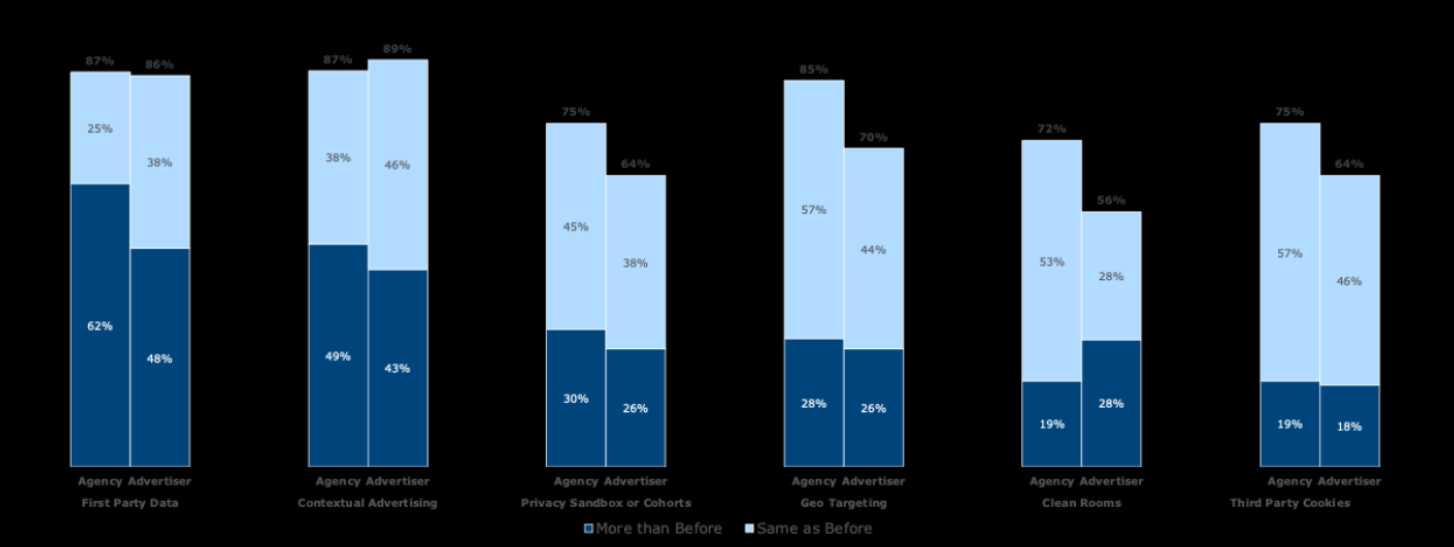
These findings do not suggest experimentation at the margins. They reflect structural adjustment. Budgets, workflows, and data strategies are being reoriented around authenticated ecosystems and privacy-aware collaboration.
At the same time, expectations around accountability have not softened. Conversion rate (80%), reach/impressions (77%), ROAS (75%), and CTR (75%) remain among the most frequently used metrics across agencies and advertisers. Sales follows closely behind. It is quite clear that the industry continues to prioritize measurable outcomes and financial performance.
What has changed is the infrastructure underneath those metrics. As identity resolution becomes more environment-specific, attribution depends increasingly on platform-level reporting, modeling, and context-dependent methodologies. Incrementality testing is present, but not standardized. Definitions vary. Approaches differ across networks.
The RMN findings make this tension visible. Within retailer-owned ecosystems — where exposure data, user identity, and transaction records coexist — advertisers can link activity to outcomes with greater precision. Deterministic reporting is strongest where identity is embedded directly in the platform. In these environments, the measurement logic is relatively contained.
However, once campaigns extend beyond retailer-controlled environments, comparability becomes more complicated. The 16 RFIs plus 7 in-depth IDIs found that offsite placements and omnichannel executions rely on different attribution systems and partner integrations, resulting in hybrid measurement architectures. No participating network demonstrated fully harmonized cross-channel exposure reconciliation. Incrementality frameworks are increasingly emphasized, but definitions and execution vary across networks. Reporting interfaces may appear consolidated, but the underlying methodologies often differ from network to network.
The result is not measurement collapse. It is fragmentation.
Behavior has shifted faster than standards have aligned. Tools have proliferated faster than definitions have harmonized. Multiple systems now operate in parallel, each with its own assumptions about exposure, identity, and impact.
This does not mean the industry is unprepared. It means the transition is uneven.
If the first phase of the post-cookie environment was about replacing lost signals, the next phase may be about governance and clarity. Clearer definitions of incrementality. Greater transparency around modeling assumptions. Improved comparability across environments. Shared standards where feasible.
ARF’s 2025 Metrics Survey documents measurable behavioral shifts: increased reliance on first-party data, widespread adoption of privacy-safe tools, and growing use of contextual approaches. At the same time, the RMN study finds that measurement architectures
remain hybrid, cross-channel exposure reconciliation is not fully harmonized, and incrementality methodologies vary across networks. The evidence therefore points to structural transition without methodological unification. Change is clearly occurring. Alignment across systems has not yet been achieved.
Third-party cookies have not disappeared entirely, but advertiser reliance has shifted decisively toward first-party data and privacy-safe collaboration, as reflected in ARF’s recent findings. The transition is not defined by the absence of cookies alone, but by the structural shift toward authenticated ecosystems and hybrid measurement systems. What remains incomplete is not adaptation, but alignment — particularly around cross-channel reconciliation and methodological standardization.
The ARF is celebrating its 90th anniversary this year. We will kick off the celebration at AUDIENCExSCIENCE, our flagship event, by examining the forces shaping advertising’s next era. Ad Club members receive a special rate. Register here and use code ACAxS26.

Author
Tracy Adams
Senior Director of Research & Insights
ARF