
Hispanic Heritage Month | Innovator: Maco Vega

Marco Vega has spent his career proving that the shortest path 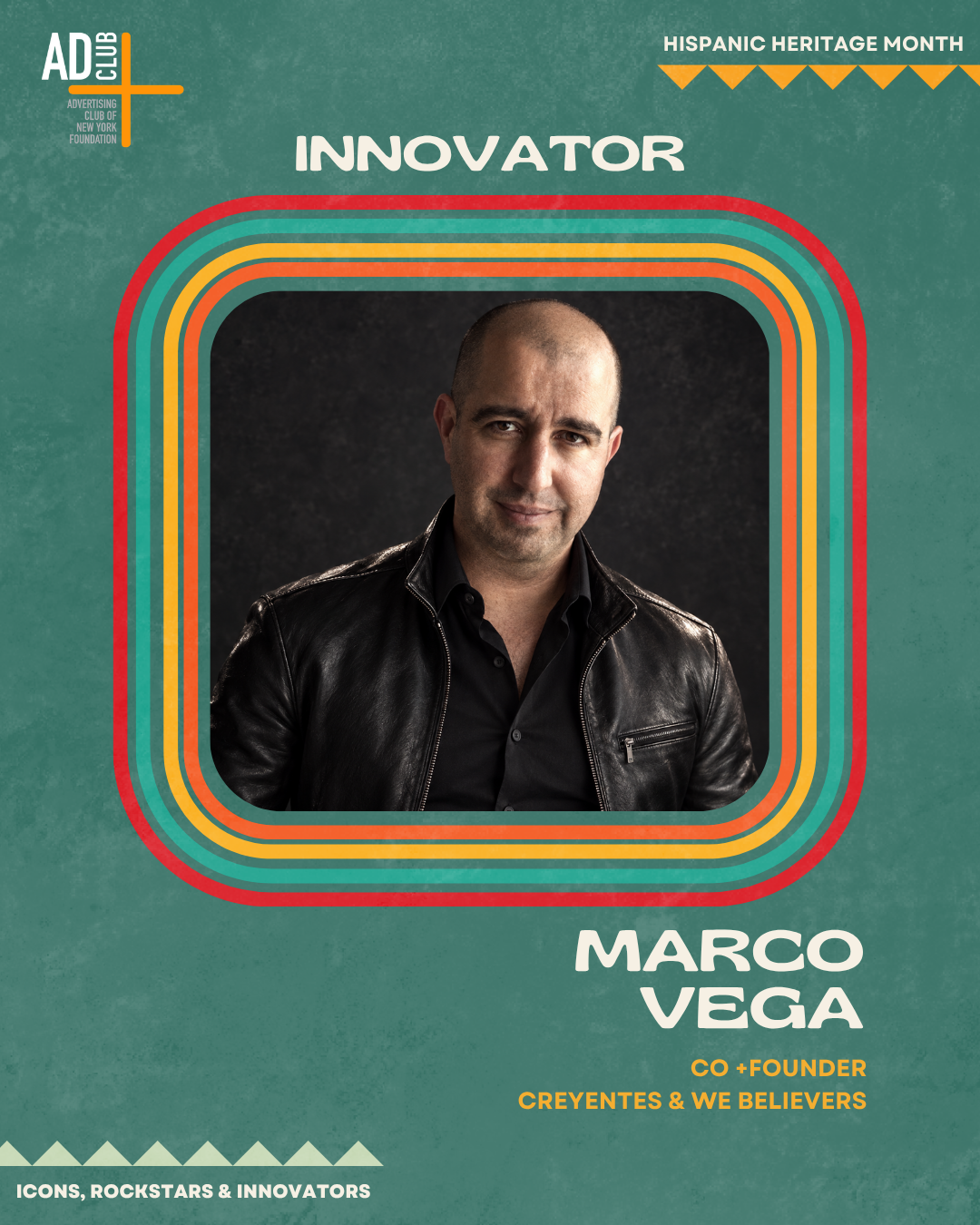 to a breakthrough is rarely a straight line. A creative strategist and engineer, he is co-founder of We Believers, Cannes Lions’ 2022 Independent Agency of the Year and Ad Age’s 2022 Creative Agency of the Year, and CREYENTES, its Latino sister consultancy. He believes in an approach he calls Creative Engineering: turning lateral thinking into tangible solutions by bringing together expert teams, partners and the resources to execute.
Born and educated in Mexico and the US, Marco earned his industrial engineering degree at Tecnológico de Monterrey, worked in manufacturing at Procter & Gamble and advised corporations at McKinsey & Company. After September 11th, he founded Flymex to help Mexican immigrants send packages home, including to remote towns. The business combined a web-based shipping platform with distribution through money-transfer and travel agents, giving him an early view of the economic potential of U.S. Latino consumers.
He entered advertising in 2004, joining a New York Hispanic agency and discovering how engineering discipline could help unconventional ideas become reality. That conviction has shaped his work for brands including Corona, Modelo, Bud Light, Burger King, Saltwater Brewery, Tequila Centenario, Charter Spectrum, Heineken, Target, Honda, and Coca-Cola, among others.
In 2014, Marco and Gustavo Lauria co-founded We Believers. One of Marco’s defining projects was the development of Edible Six-Pack Rings for Saltwater Brewery as an alternative to plastic packaging. He co-invented the product and led the engineering team that brought the concept to a working prototype. The innovation led to Pack2Zero, a sustainable packaging company where he is a co-founder and board member.
For Burger King, he assembled the development team and negotiated data access for a service delivering Whoppers to drivers stuck in traffic. He also worked with scientists to test a natural feed supplement that reduced cattle methane emissions by up to 33% in trials.