
Privacy, Trust and AI: What Consumers Expect Now

What do consumers really want from brands today? More relevance, certainly. But also more restraint. New research presented at ARF’s AudiencexScience suggests that privacy is now the baseline expectation, trust is conditional, and AI will only work for brands when consumers feel they still have visibility and control.
The data presented here combine findings from two recent U.S. consumer studies: the ARF’s 8th Annual Privacy Study (January 2026, n=1,245) and Humantel’s Privacy & Trust Study (November 2025, n=4,014), offering both longitudinal perspective and broader scale.
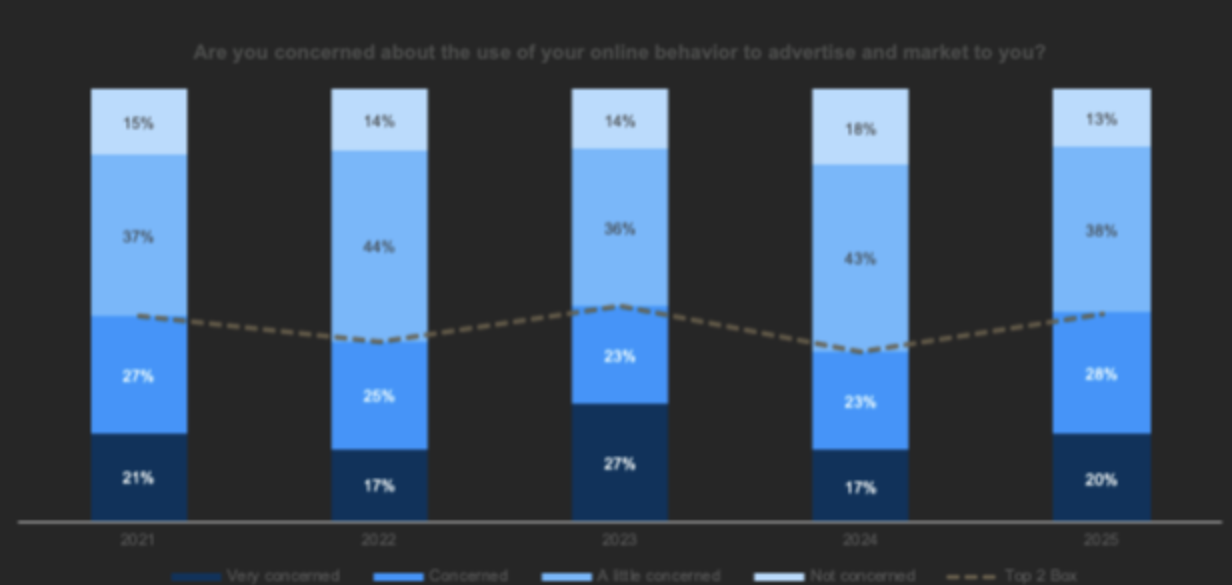
Privacy is no longer a “nice to have” or a brand differentiator. It is the starting expectation. In fact, 68% of consumers strongly believe that privacy is a basic right (Humantel, 2025). Concern about the use of online data for advertising purposes rose to 48%, returning to the same level observed in 2021 (ARF, 2026). That year-to-year movement suggests that while specific anxieties may rise and fall with the broader environment, baseline concern remains persistent (see Figure below).
That said, consumers are not rejecting data sharing altogether. In fact, willingness to share data increases when the value exchange is concrete, immediate and useful. Nearly 60% are willing to share purchase history for personalized recommendations (ARF, 2026). And when consumers do see benefits, those benefits are practical: 41% say tailored promotions are a significant benefit, 40% say data sharing can reduce irrelevant ads, and 37% say it can make shopping quicker (Humantel, 2025). The issue is not personalization itself. The issue is whether personalization feels proportionate, purposeful and under the consumer’s control.
Control emerged as a critical driver of comfort. People feel more at ease when they can see what data is being collected, decide who it is shared with and delete it easily. Specifically, 56% say the ability to easily delete shared data would very much improve comfort, 55% say control over who data is shared with would do so, and 53% say seeing what data is collected would help (Humantel, 2025). That suggests a shift in how marketers should think about privacy. The old framing of “privacy versus personalization” no longer holds. Consumers are willing to engage in pragmatic data exchange, but only when they believe the terms are clear and fair.
Trust is improving, but it remains conditional. The ARF data suggests that institutional trust rebounded in 2025, with trust increasing across every category measured and, for many institutions, reaching the highest levels observed since 2020 (ARF, 2026). Yet a significant gap remains between consumer expectations and consumer understanding. Only 26% feel they have a good understanding of how their information is used; 61% say advertisers should offer a universal opt-out; and 65% say it is very important that advertisers keep contact and purchase information secure (Humantel, 2025). In other words, trust is not blind confidence in institutions. It is increasingly trust enabled by visibility and control.
AI adds another layer, but it does not fundamentally change the equation. Consumers are becoming more accustomed to AI and more willing to use it in everyday experiences, but concern about privacy remains high. Sixty-two percent are concerned or very concerned about AI’s impact on their privacy (ARF, 2026), and 49% are very concerned about AI improperly using information to create or show inappropriate ads (Humantel, 2025). What people seem to accept is AI as an assistant. What they are less comfortable with is AI acting autonomously in ways that feel opaque or intrusive. Importantly, consumers are not necessarily asking for technical explanations of models and systems. They are asking for clarity about data: what is being used, why it is being used and how it is being protected.
For brands, the implications are clear. Privacy is now the entry requirement. Trust is conditional and must be reinforced through consumer agency. And AI will magnify existing perceptions of fairness, transparency and control rather than replace them. The organizations that will succeed are not the ones that simply use more data or more AI. They are the ones that design experiences where data use feels relevant, restrained and visible to the consumer.
The opportunity for marketers is not to choose between personalization and privacy. It is to build systems where relevance is delivered in ways that respect the consumer from the start. That is where trust is built, and where the future of advertising will be decided.
Author
Tracy Adams, PhD
Senior Director of Research & Insights
ARF

SOURCES
Advertising Research Foundation. (2026, January). The ARF 8th annual privacy study. The ARF.
Humantel. (2025, November). Humantel Ads – privacy & Trust Study.