
Retail Media Measurement in Practice: What Buyers Are Telling Us

Retail media has long had a compelling measurement proposition: connect advertising exposure to transaction data and show what happened next. But as retail media has expanded across onsite, offsite and in-store environments, that promise has become harder to deliver consistently.
The first phase of the ARF Retail Media Network Standardization Project examined measurement from the network side. It found that closed-loop measurement was strongest within retailer-controlled environments, while offsite measurement relied more heavily on partner integrations, platform reporting, clean rooms and modeling. No participating network demonstrated fully harmonized measurement across onsite, offsite and in-store environments (ARF, 2026).
The second phase, conducted with The Advertising Club of New York, turns to the buy side. A detailed RFI among advertisers and agencies asked what buyers actually receive from retail media networks, where measurement breaks down and what they need next. The findings are based on 13 responses and should be viewed as directional, However, the sample included substantial buying organizations: eight respondents represent very large global advertisers across categories including CPG, insurance and automotive, alongside agency and other industry perspectives. The findings therefore provide a useful view into how retail media measurement challenges are playing out among major buyers.
Incrementality is becoming the higher standard
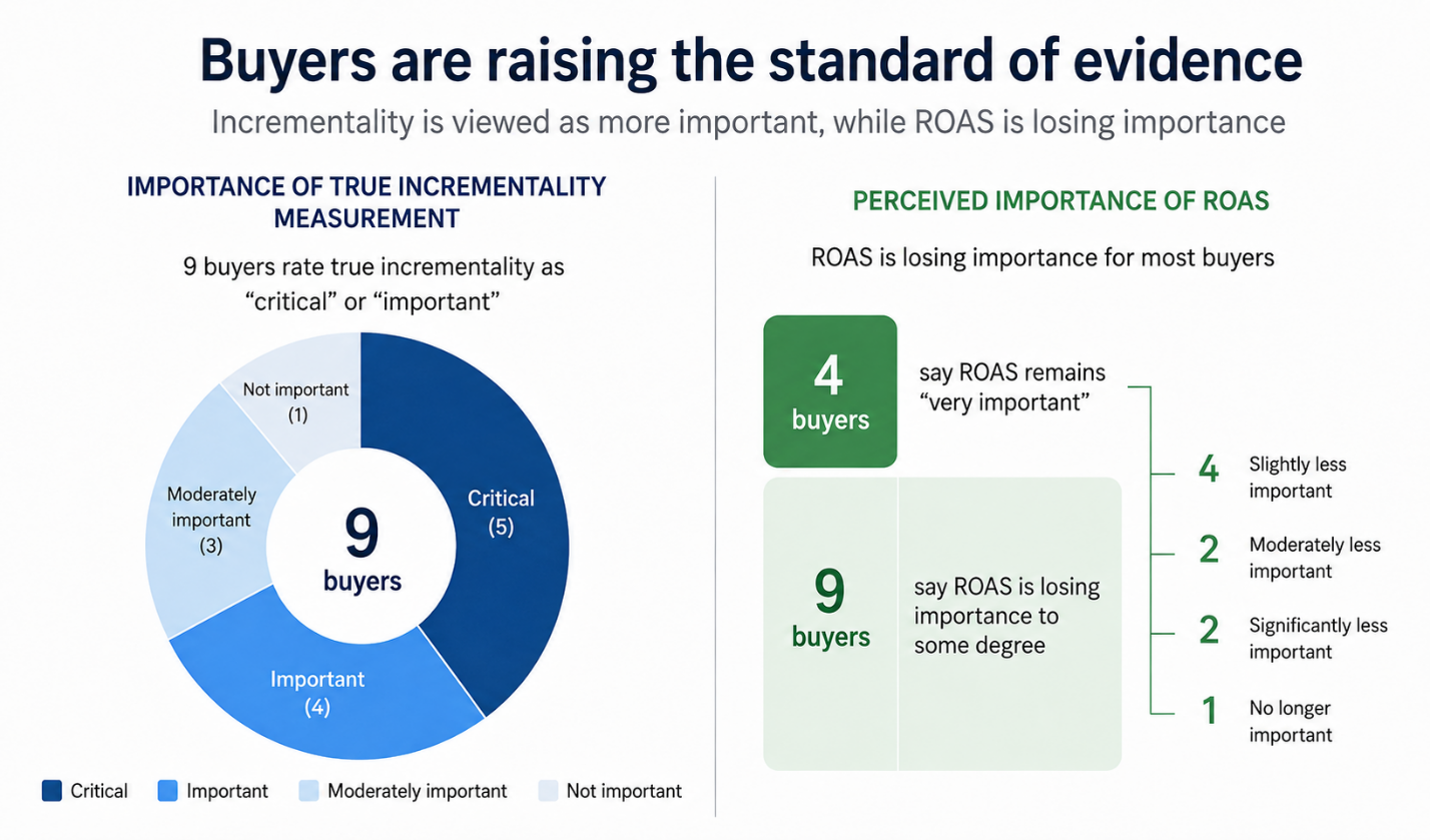
Buyers are drawing a sharper distinction between attributing sales to advertising and demonstrating that advertising actually caused additional sales.
ROAS remains useful, particularly for in-flight optimization, but most buyers characterized true incrementality measurement as important or critical. This builds on the ARF’s 2025 advertiser and agency study, where ROAS was used by 67% of current RMN users compared with 51% using incrementality (ARF, 2025).
“High ROAS does not mean high incremental sales.”— Large global CPG advertiser
The distinction matters because attribution and incrementality answer different questions. Attribution connects purchases with advertising exposure; incrementality asks whether those purchases would have happened without the advertising.
Access remains uneven, however. Buyers reported using a range of causal approaches, but several said not all of the networks they work with support incrementality testing. Even when lift is reported, buyers may not receive enough information about control groups, baselines or statistical methodology to evaluate the result independently.
The same metric does not always mean the same thing
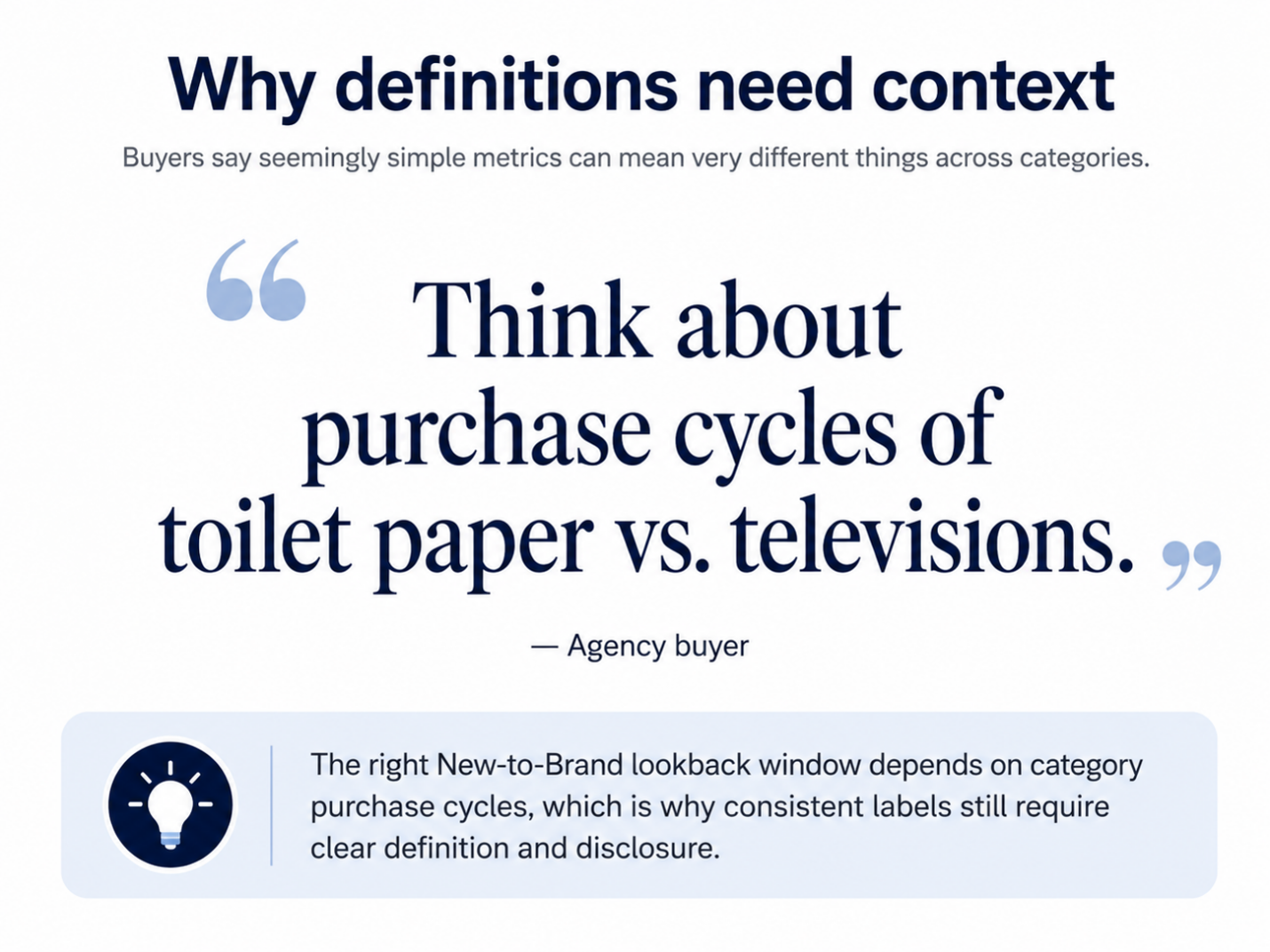
Comparability is another persistent challenge. The ARF’s 2025 research found that 55% of marketers viewed lack of standardization across RMNs as a significant barrier. The current RFI shows what that inconsistency can look like in practice: attribution windows, New-to-Brand definitions, halo sales and conversion rules may differ even when networks use the same metric labels.
New-to-Brand provides a particularly clear example. One agency buyer asked advertisers to: “Think about purchase cycles of toilet paper vs. televisions.”
The appropriate lookback period can vary dramatically depending on how frequently a category is purchased. Another respondent pointed out that someone may be new to a brand within one retailer’s data while already purchasing the brand elsewhere.
Current industry standards increasingly emphasize precisely these issues: transparency around attribution windows, definitions and methodological choices is central to both the IAB/MRC Retail Media Measurement Guidelines and IAB Europe’s Commerce Media Measurement Standards (IAB & MRC, 2024; IAB Europe, 2026).
Measurement quality is becoming a business issue
Measurement inconsistency also creates operational work. Buyers described spending meaningful time normalizing RMCN data and reconciling network-reported performance with other measures of sales and effectiveness.
One agency buyer summarized the challenge bluntly: “Fragmentation is killing our industry and that becomes so pronounced in retail media.”
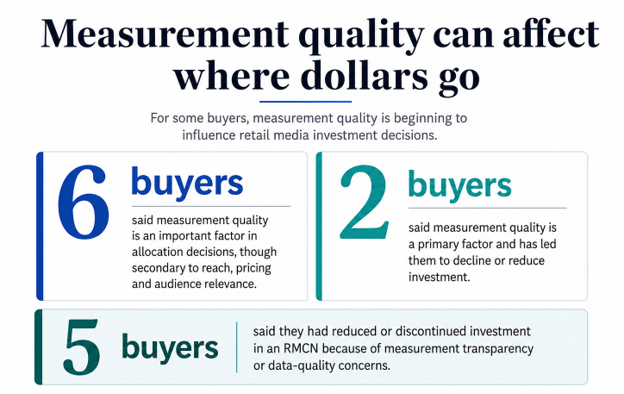
But perhaps the most consequential finding is that measurement quality is beginning to influence investment decisions. Some buyers reported reducing or discontinuing spending with an RMCN because of transparency or data-quality concerns.
That changes the stakes. Measurement quality is becoming part of the investment decision itself, not simply a reporting concern.
The message from buyers is relatively consistent: they are not primarily asking for more metrics. They want stronger deduplication, clearer definitions, better disclosure, access to underlying data and more credible incrementality measurement.
The next step for retail media measurement is not simply measuring more. It is making the measures buyers already use easier to understand, compare and trust.
References
Advertising Research Foundation. (2026). The ARF Retail Media Network Standardization Project: Capabilities, Metrics & Practical Guidelines. ARF.
Advertising Research Foundation. (2025). Retail Media Networks: Navigating Metrics, Challenges and Opportunities. ARF.
Interactive Advertising Bureau & Media Rating Council. (2024). IAB/MRC Retail Media Measurement Guidelines.
IAB Europe. (2026). Commerce (Incl. Retail) Media Measurement Standards V2.1.
Author
Tracy Adams, PhD
Senior Director of Research & Insights
ARF