
The AI Adoption Gap: Organizations Don’t Have an AI Problem, They Have a Business Problem They Haven’t Pinned Down
Byline: Co-Authors Jean Marc Papin, Blue Wind Advisory & Pedro L. Rodriguez, PLR Group Inc.
If there was one theme that emerged from conversations at Cannes Lions this year, it was this: organizations have moved beyond asking whether they should invest in AI. They’re now asking where AI actually creates value.
At the Shelly Palmer Innovation Series breakfast, leaders from Taco Bell, Uber, U.S. Bank, Adobe, OpenAI, and others approached the topic from different perspectives, but arrived at a similar conclusion: successful AI adoption isn’t about the technology itself. It’s about connecting technology to business outcomes.



That may sound obvious, but the data suggests many organizations are still struggling to do exactly that.
According to Foundry’s 2025 Cloud Computing Study, 66% of IT decision-makers plan to invest in cloud-based AI. Yet nearly one-third (31%) cite unpredictable costs as a major concern, while 27% struggle with complex pricing models.
Meanwhile, marketers face a different challenge. Research shows that 67% cite a lack of education and training as a key barrier to AI adoption, while 43% point to the absence of a clear strategy.
The result? Companies are investing in AI before they understand where it fits, who should use it, and how success should be measured.
The question shouldn’t be “How do we use AI?”
The question should be: “Where does AI create measurable value for our business?”
At Cannes, several examples highlighted what that looks like in practice:
- Adobe’s Hannah Elsakr discussed how AI can unlock creative breakthroughs, including how Nestlé used AI to refresh existing KitKat creative around Formula 1. Disney shared how it is building proprietary models and knowledge graphs around its intellectual property, reinforcing an important lesson: in an AI-driven world, the competitive advantage is rarely the model itself. It’s the unique assets, data, and expertise that power it.
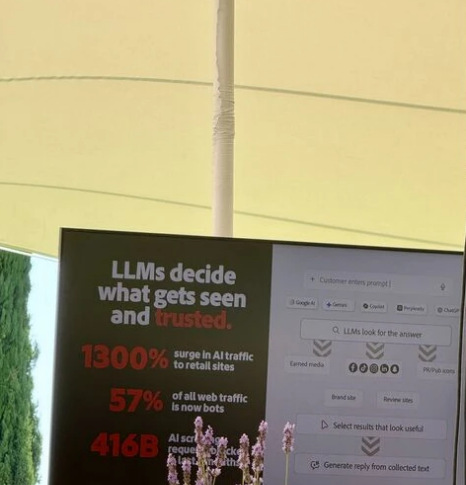
- OpenAI’s David Dugan noted that approximately 20% of queries now have commercial intent, signaling a profound shift in how consumers discover products, evaluate brands, and make decisions.
These examples have one thing in common: they begin with a business objective, not a technology solution. That’s where many organizations need support and PLR Group Inc. collaborates with Blue Wind Advisory for this purpose. Its deep data expertise coupled with our marketing capabilities, provides brands with targeted expertise.
AI readiness starts with three foundational questions:
- What is uniquely valuable about your business? The goal is not to deploy AI for the sake of innovation. The goal is to identify where the value is created and which are the assets, customer insights, intellectual property, or any other operational advantages that make your organization different. If we take at Starbucks for example, they have created Deep Brew AI platform to analyse to deliver tailored mobile app promotions, significantly increasing average order value and customer retention.
- Who creates value inside the organization? We focus on the “Business practitioners” who are actually performing the work: marketing leaders, sales teams, customer service representatives, analysts, and operators. These are the people who understand the business, influence revenue, and ultimately determine whether AI adoption succeeds. XP Inc. implemented enterprise AI assistants, saving employees over 9,000 hours previously spent on administrative data gathering and report generation. They reallocated that time toward high-value financial risk analysis and client strategy.
- What data and processes are required to support them? Before implementing AI, organizations need to understand the accessibility, quality, governance, security, and operational readiness of the data that powers decision-making. Those subjects, are most of the time, avoided. A notable ad tech suffered massive performance dips and financial losses in its Audience Pinpoint platform because the AI ingested corrupted customer data, ruining its training models and rendering its ad-targeting metrics inaccurate. Those preparation tasks are foundational in a successful AI use case.
Only by meeting all those conditions then can AI become an accelerator rather than an expensive experiment.
The opportunity is enormous and waiting has a cost in such a fast-changing environment. Organizations that successfully align AI investments with business goals will improve efficiency, unlock new revenue streams, enhance customer experiences, and create competitive advantages. Those that don’t risk spending more, moving slower, and generating little return. AI implementation is about business transformation. And the organizations that win won’t necessarily be the ones with the most advanced tools. They’ll be the ones that best connect people, processes, data, and strategy.
Before investing another dollar in AI, ask yourself a simple question:
Do you know exactly where AI creates value in your business?
If not, that’s where the conversation should begin. Let’s connect on how we can help your organization assess AI readiness, identify high-value opportunities, build adoption roadmaps, and equip teams with the training and governance needed to drive measurable business outcomes.
Authors
Jean Marc Papin, Blue Wind Advisory
Pedro L. Rodriguez, PLR Group Inc